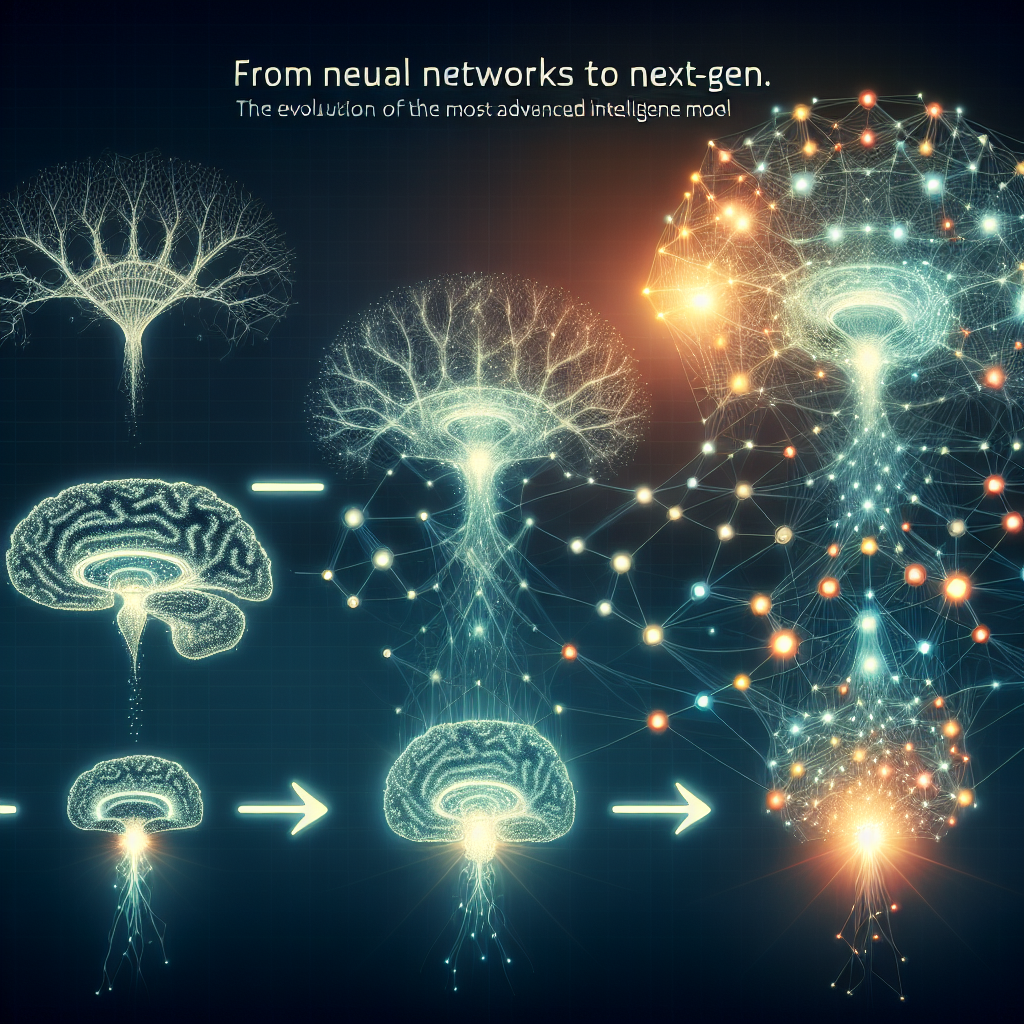
The realm of artificial intelligence (AI) has undergone a seismic shift over the last few decades. From primitive algorithms to complex neural networks and now to the next generation of AI models, the evolution has been nothing short of remarkable. This article delves into this evolution, exploring its key milestones, current advancements, and the future trajectory of AI technologies.
Table of Contents
- Introduction
- The Birth of Neural Networks
- Milestones in AI Development
- Deep Learning Revolution
- Transformers and Their Impact
- Current State of AI Models
- Next-Generation AI Models
- Generative Pre-trained Transformers (GPT)
- Reinforcement Learning Models
- Applications of Next-Gen AI
- Challenges Facing AI Development
- Conclusion
Introduction
Artificial intelligence has transitioned from simple algorithms to advanced models that can solve complex problems across various sectors. Entrepreneurs, marketers, and business owners find themselves at the forefront of this revolution, needing to understand these technologies to stay competitive. As we delve into this evolution, we will illuminate how neural networks paved the way for today’s most advanced AI models.
The Birth of Neural Networks
Neural networks were first conceptualized in the mid-20th century, drawing inspiration from the human brain’s architecture. An essential feature of neural networks is their ability to learn from data. This learning process involves multiple layers of interconnected nodes, known as neurons, that simulate human decision-making.
The Early Years
The initial models, such as the Perceptron developed by Frank Rosenblatt in 1958, were groundbreaking yet limited in capability. These early iterations based on simple linear classifiers struggled with non-linear data—a challenge that wouldn’t be surmounted until several decades later.
Backpropagation
The introduction of backpropagation in the 1980s allowed for better training of neural networks. By calculating the gradient of the loss function, models could learn more efficiently from errors, marking a pivotal step in the advancement of AI.
Milestones in AI Development
Significant milestones in AI history include the advent of deep learning and the introduction of transformer models. These advancements have had profound implications for AI capabilities and applications.
Deep Learning Revolution
The deep learning revolution began in the 2010s with a surge of computational power and the availability of big data. Researchers like Geoffrey Hinton designed multi-layered neural networks capable of processing vast amounts of information, resulting in significant improvements in fields such as image and speech recognition.
Transformers and Their Impact
Introduced in a groundbreaking paper by Vaswani et al. in 2017, transformer models shifted the landscape of natural language processing (NLP). Transformers utilize a mechanism called attention, allowing them to weigh the significance of different words in a sentence. This advancement led to more fluent and contextually aware models.
For an in-depth look at transformer technology, you can refer to the original paper on Attention is All You Need.
Current State of AI Models
Today, models like BERT, GPT-3, and their successors represent the zenith of NLP technology. These models are trained on extensive datasets and can produce human-like text, making them invaluable for applications in customer service, content creation, and more.
Features of Current AI Models
- Natural Language Understanding: Current AI can comprehend and generate human-like text, allowing for seamless interactions.
- Context Awareness: The ability to maintain conversation context is crucial in applications like virtual assistants.
- Multimodal Capabilities: The integration of text, images, and developing modalities such as audio enhances user experiences.
Next-Generation AI Models
As we continue to innovate, the next generation of AI models is upon us, characterized by more sophisticated architectures and improved functionalities.
Generative Pre-trained Transformers (GPT)
GPT models, particularly the advancements seen in GPT-4, have revolutionized AI comprehension and generation of text. These models are trained on a diverse range of internet text, allowing them to generate coherent, contextually relevant, and often creative responses.
Reinforcement Learning Models
Reinforcement learning (RL) has also made tremendous strides. RL models learn optimal behaviors through trial and error, allowing them to adapt to complex environments. This is particularly useful in sectors such as gaming, robotics, and autonomous systems.
Applications of Next-Gen AI
The applications of next-generation AI are vast and varied, including but not limited to:
- Customer Service Automation: AI models can manage queries, improving response times and efficiencies.
- Content Generation: Marketers utilize AI for ad copy, blog posts, and social media content, driving engagement.
- Healthcare Solutions: AI assists in diagnosing diseases, personalizing treatments, and managing healthcare data.
For more insights into AI applications, explore our article on How AI Transforms Digital Marketing.
Challenges Facing AI Development
Despite these advancements, several challenges still hinder the full realization of AI’s potential:
- Bias in AI Models: AI systems can inherit biases from training data, leading to unfair outcomes.
- Data Privacy Concerns: The collection and use of personal data raise ethical questions regarding privacy.
- Interpretability: Understanding how AI models make decisions is crucial for trust and transparency.
Conclusion
The evolution of AI from neural networks to next-generation models showcases an incredible journey of technological advancement. Understanding this evolution is essential for entrepreneurs, marketers, and business leaders who aim to harness AI’s full potential. As we move into the future, continuous improvement and responsible deployment of AI technologies will shape our world in unprecedented ways.
By staying informed and engaged with these developments, stakeholders can leverage AI not only for improving their operations but also for creating innovative solutions that address the challenges facing humanity today.
This article provides an in-depth overview of the evolution of AI technologies. For further exploration of relevant topics, visit our other articles on Artificial Intelligence and Machine Learning.